


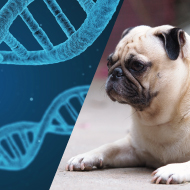
Test to assess dog’s risk of developing severe disease
A new official DNA testing scheme for pug dog encephalitis (PDE) has been approved by The Kennel Club following consultation with the pug breed health coordinator on behalf of the breed clubs.
PDE is an inflammatory brain disease that is typically progressive and fatal. Signs that a dog is developing the condition can include seizures, blindness and not walking correctly.
PDE is considered a priority condition and The Kennel Club, breeders and breed clubs are eagerly working towards eventually eradicating the disease from the breed.
As opposed to providing a definitive result, the test for PDE evaluates the risk level a dog has of developing the condition, therefore results are recorded for individual dogs only and progeny cannot be assigned as ‘hereditarily clear’. Dogs that have been tested will be recorded on the Kennel Club system as either:
- Minimal risk (0) - the dog has no copies of the PDE gene variant and is at minimal risk of developing PDE.
- Minimal risk (1) - the dog has only one copy of the PDE gene variant and is still at minimal risk, but it may pass the gene on to future puppies.
- Increased risk (2) - the dog has two copies of the gene variant and has an increased risk of developing PDE.
Only dogs with two copies of the gene variant have an increased risk of developing the disease, and only an estimated one in eight of these dogs will actually ever be affected.
Test results will be added to the dog’s registration details and will be published in the next available Breed Records Supplement, as well as appearing on any new registration certificate for the dog or for any of its’ future progeny. Finally, the results will be added to the Health Test Results Finder on the Kennel Club website.
Gary Johnson, breeder services manager at The Kennel Club, said: “The Kennel Club constantly reviews DNA testing schemes in conjunction with breed clubs to ensure that breeders are supported with resources which help them to make responsible breeding decisions.
"DNA technology is making huge advances year upon year. It is very good news that pug breeders are taking advantage of this technology which will be of huge benefit as breeders work towards eradicating this condition from this popular and loving breed.”


 Eligible members of BEVA will be able to vote for their Council team until Monday, 17 August 2026. Members will have received an election email on 17 July.



